

1—Zomato: company snapshot
Zomato launched in 2008 as a menu and restaurant discovery utility and evolved into a multi-vertical food-tech platform: food delivery, quick commerce (Blinkit), B2B supplies (Hyperpure), and going-out/dining. In FY24 the quick-commerce business (Blinkit) emerged as a major growth engine, materially lifting GOV and order volumes across the consolidated group. Zomato’s public filings and investor materials make this transition traceable in numbers and strategy.
2—Growth arc: from menu scans to platform scale
The arc is simple, but execution is hard: solve a real pain (menus → discovery), prove product value, add adjacent services (delivery → groceries → B2B), then scale distribution and monetization. Key inflection points:
- 2008–2014: discovery and reviews, building trust & network effects.
- 2015: delivery becomes a core product — the platform starts routing monetizable transactions.
- 2020s: acquisitions (e.g., Blinkit) and product diversification; platform moves from single-use utility to multi-service habit.
By FY24 the company had substantial GOV expansion in quick commerce and a step-change in order volumes and monthly transacting customers for that vertical — the payoff of supply density and localization.
3—How Zomato makes money—the revenue engine (concise breakdown)
Zomato’s business model is multi-headed; monetization happens across product, ad and service layers:
- Platform fees & commissions — restaurants pay for orders and for on-platform prominence.
- Quick commerce revenue — Blinkit sales generate GOV and direct revenue; as store density and AOV rise, so does revenue.
- Subscriptions & loyalty — membership offers (Gold/Pro) drive engagement and higher lifetime value.
- Ads & promoted listings — in-app real estate is monetizable and high margin.
- B2B (Hyperpure) — selling ingredients and supplies to restaurants provides a differentiated margin stream.
FY24 quick-commerce evidence (core facts): in FY24 Blinkit’s GOV scaled to ₹12,469 crore (≈93% YoY growth), order volumes grew to 203 million (≈71% YoY), and AOV expanded — direct proof that distribution + demand economics improved materially.
4—Who uses Zomato? (audience anatomy)
Primary audiences:
- Urban 18–35s (students, professionals) — habits of frequent meal ordering and mobile usage.
- Working couples and multiplexed households — high lifetime ordering frequency.
- Small restaurants and cloud kitchens — business users of Hyperpure and promotional products.
Zomato’s segmentation is behavioral: time of order, cuisine affinity, price sensitivity, and local availability. That gives marketing very granular targeting hooks.
5—Competition: Zomato vs Swiggy (and quick-commerce entrants)
Two axes define the rivalry:
- Brand & content — Zomato’s irreverent voice vs Swiggy’s utility-first tone.
- Fulfillment & speed — Swiggy and other players (Instamart, Zepto) fight supply/density and cost economics. The quick-commerce race (Blinkit vs Instamart and others) is capital and execution intensive. Industry reports show Blinkit’s strong GOV density and higher take-rates vs peers, but rising competition pressures margins and requires continuous investment.
6—The marketing playbook (deep dive — how the machine actually runs)
Zomato’s go-to-market couples creative virality with performance plumbing and distribution economics. Tactically:
1. Brand voice as a low-cost amplifier
Witty, culturally tuned social posts and push notifications create organic traction and earned media; this reduces paid CAC and amplifies product launches.
2. Product-led activation
In-app messaging, onboarding flows and first-order offers turn awareness into trial. Loyalty mechanics and periodic offers push frequency.
3. Geo & supply alignment
Quick commerce requires store density; marketing focuses neighborhood spend where delivery times and inventory availability are strongest — a practical, ROI-driven media map.
4. Measurement & optimization
Zomato tracks orders, AOV, GOV, transacting customers and adjusted EBITDA by business unit; campaign teams optimize to these end-KPIs. FY24 investor reporting emphasizes GOV and orders as the core unit economics to be shifted.
7—Viral campaigns, creative branding & loyalty programs
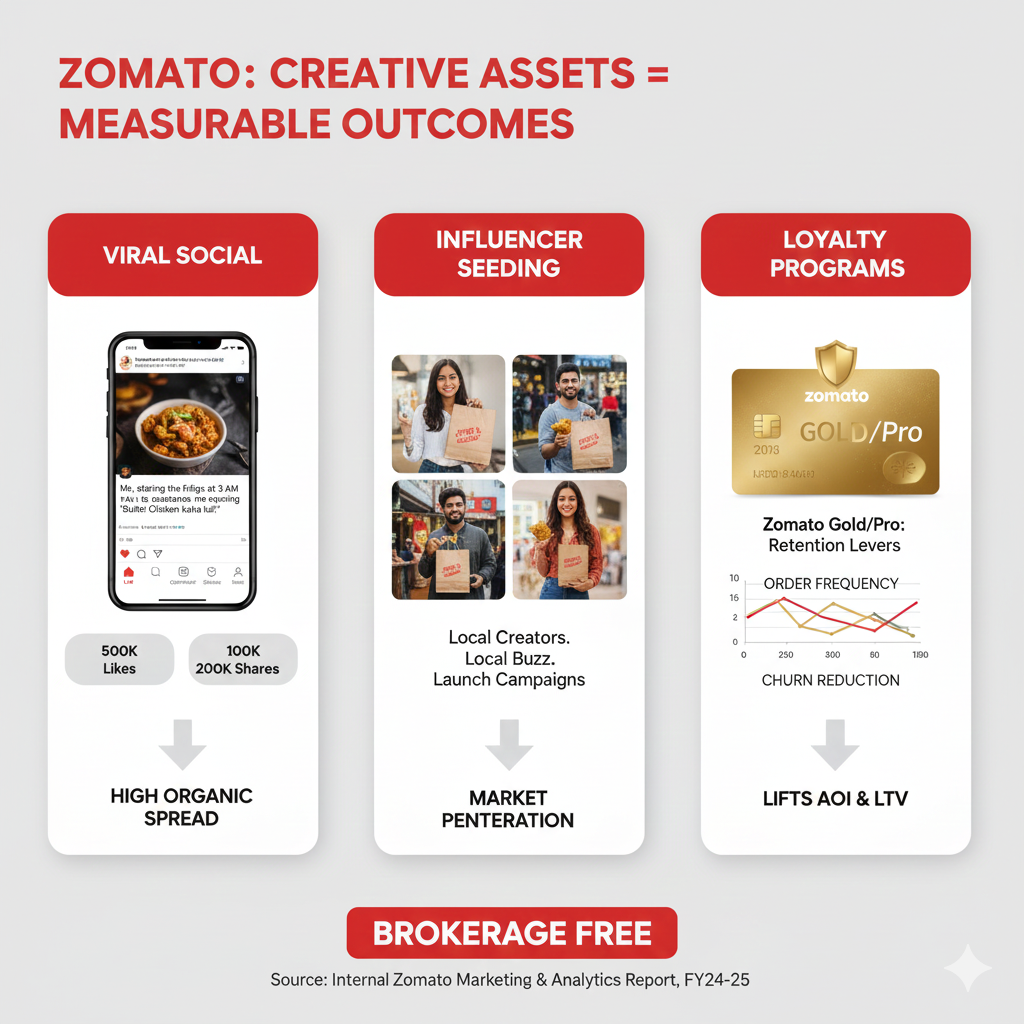
Zomato converts creative assets into measurable outcomes:
- Viral social: posts that are culturally tuned, creating high organic spread.
- Influencer seeding: local creators for launch & local market buzz.
- Zomato Gold/Pro: membership mechanics that reduce churn and lift average ordering frequency (and perceived value). These are retention levers, not vanity metrics.
8—Data, personalization & UX as conversion fuel
Zomato’s personalized recommendations, search ranking and push cadence are grounded in rich behavioral signals — order history, time of day, local supply, and promotional responsiveness. The product layer reduces friction (one-tap reorder, local favorites), turning acquisition into reproducible revenue. The FY24 investor commentary highlights investments in product and data to scale retention and monetize new verticals.
9—Headwinds & pragmatic risks
- Unit economics under pressure: aggressive store rollouts for Blinkit increase near-term adjusted losses even as GOV rises. FY25 quarter letters show investment-led dips in adjusted EBITDA for quick commerce.
- Competition: players such as Swiggy (Instamart), Zepto and large retail platforms are competing on speed and price.
- Macro demand swings: consumer spend cycles affect average order frequency and AOV.
These risks are manageable but require disciplined measurement and channel ROI sprints.
10—Actionable lessons for marketers & startups
- Align marketing with operations: for on-demand businesses the media plan must match supply capability. Market neighborhoods where delivery timelines are demonstrably strong.
- Use brand voice to lower CAC: cultural, sharable creative pulls paid costs down by increasing organic reach.
- Measure the right KPIs: orders, GOV, AOV and monthly transacting customers — not vanity metrics. Tie creative tests to these measures.
- Invest in retention: incremental LTV from membership/loyalty often outperforms marginal acquisition spend.
11 — ACME Advertising Co. — how we’d scale a Zomato-style business (OOH, Retail, Transit, Electronic & POSM)
Zomato’s growth blueprint shows the value of aligning media with product density. ACME slices channel spend to tactical KPIs.
OOH (Hyperlocal hoardings & shelter kits)
- Target: micro-clusters around newly opened quick commerce stores and high commuter corridors.
- Objective: boost local app installs and first orders within a 1–3 km radius.
- KPI: geo-tagged installs and first-order rate uplift.
Retail media (co-branded islands & QR activations)
- Target: grocery stores and partner outlets.
- Objective: convert walk-in shoppers into app users with instant coupons.
- KPI: coupon redemptions and AOV of app first orders.
Transit (bus flanks, metro card panels)
- Target: office corridors and college routes — peak commute impressions.
- Objective: drive lunchtime and dinner conversions with time-boxed creative.
- KPI: uplift in midday and evening order volumes in campaign zones.
Electronic / DOOH (dynamic creative)
- Target: high-footfall retail and mall precincts.
- Objective: rotate creative by hour (breakfast/lunch/dinner) and surface time-relevant promos.
- KPI: QR scans, promo redemptions, campaign CTR to landing page.
POSM (in-store branding & table tents)
- Target: partner restaurants and cloud kitchen pickups.
- Objective: reduce friction — “order again via app” with single-tap QR/UTM.
- KPI: repeat order uplift within 30 days.
Pilot (30 days)
- Micro-OOH + DOOH + retail islands + POSM + geo-targeted social.
- Measure installs, first orders, AOV, redemption rate and CPFO (cost per first order). ACME provides weekly sprint reports and creative iteration.
How Did Zomato Build a Strong Brand Through Marketing?
Zomato built its brand by combining food-related content, memorable creative communication, digital campaigns and a strong understanding of consumer behaviour. Instead of relying only on direct promotional messages, the brand developed a recognizable communication style that could connect with everyday food moments.
Its marketing often uses simple copy, humour, cultural relevance and timely conversations to make advertisements feel more relatable. This approach helps the brand remain visible while creating communication that consumers can easily understand and remember.
For businesses, the key takeaway is that effective marketing does not always require complicated messaging. A clear brand personality, consistent communication and campaigns designed around customer interests can help increase awareness and create stronger engagement.
What Marketing Strategy Made Zomato Popular Among Indian Consumers?
Zomato’s marketing strategy combines digital advertising, social media communication, promotional campaigns, brand partnerships and personalized customer engagement. The company has also used its large consumer base and transaction data to develop advertising solutions for restaurants and other businesses.
The brand’s communication frequently connects with situations consumers already experience, such as ordering food during festivals, watching sports, working late or dealing with everyday cravings. This makes the advertising more contextual instead of appearing completely separate from the customer’s daily life.
Businesses can apply a similar approach by understanding when and where their target customers interact with the brand. Combining creative communication with customer data can help companies build campaigns that are both memorable and commercially relevant.
How Does Zomato Use Digital Marketing to Reach Customers?
Zomato uses multiple digital channels to communicate with customers, including social media, digital advertising, app-based communication and targeted promotional campaigns. Its platform also allows restaurants to advertise to consumers based on factors such as location, food preferences and transaction behaviour.
This type of targeted marketing allows businesses operating through the platform to reach audiences that are more relevant to their products or services. Zomato’s advertising offerings include solutions designed around visibility, customer acquisition and measurable campaign performance.
For marketers, this demonstrates why audience segmentation is important. Instead of communicating the same message to everyone, brands can use customer interests, location and behaviour to develop more relevant campaigns and improve the efficiency of their marketing efforts.
What Can Businesses Learn from the Zomato Marketing Case Study?
One major lesson from Zomato is the importance of developing a distinctive brand voice. Its marketing became recognizable because the company consistently used a communication style that was simple, relatable and closely connected to food and everyday consumer behaviour.
Another important lesson is the combination of creativity and data. Creative campaigns can attract attention, while customer insights can help businesses understand which audiences, locations and messages are more commercially valuable.
Businesses can therefore use the Zomato case study as a reference when planning their own marketing strategy. A strong campaign should combine clear positioning, audience understanding, consistent communication and measurable business objectives rather than depending on creativity alone.
How Can Brands Use Zomato’s Marketing Lessons in Their Own Campaigns?
Brands can take inspiration from Zomato by creating advertising that connects their products with real customer situations. Instead of repeatedly presenting a sales message, businesses can develop content around occasions, conversations, trends and everyday problems that matter to their target audience.
The strategy can also be extended across different advertising channels. Social media, digital advertising, outdoor advertising, influencer campaigns and location-based promotions can work together when they follow the same brand message and target the same customer segments.
For businesses planning a campaign, the focus should ultimately be on relevance and consistency. Understanding the audience, creating memorable communication and tracking campaign responses can help turn advertising from simple visibility into sustained customer engagement and business enquiries.
Frequently Asked Questions :
1. How did Zomato use marketing to build strong customer awareness?
As a client, I can learn from Zomato’s approach of becoming useful before directly selling a product. Zomato initially built its audience around restaurant search and discovery, creating regular customer engagement before expanding further into online ordering.
2. How did Zomato turn customer discovery into business opportunities?
As a client, I can use the same principle by connecting customer discovery with an easy next action. Zomato used its existing restaurant-search traffic as a foundation for moving users toward online food ordering, showing how an established audience can support a new revenue opportunity.
3. What can my brand learn from Zomato’s customer-focused marketing strategy?
As a client, I can focus on understanding what customers are already trying to accomplish instead of simply pushing advertisements. Zomato built its search and discovery experience around customer preferences, intent, location, and behaviour, making recommendations more relevant to individual users.
4. How did Zomato use personalization to improve marketing performance?
As a client, I can use audience data to make promotional messages more relevant to different customer groups. Zomato has described using factors such as customer preferences, spending patterns, dietary choices, previous orders, meal times, and weekdays to improve the relevance of promoted restaurant recommendations.
5. Can Zomato’s marketing strategy help my business generate more customer actions?
Yes. As a client, I can connect advertising directly with measurable actions such as clicks, orders, enquiries, website visits, or store visits. Zomato’s advertising solutions are designed around customer targeting and report metrics including reach, clicks, GMV, and campaign performance.
6. How did Zomato use offers and loyalty to encourage customer engagement?
As a client, I can use relevant offers, memberships, and loyalty benefits to encourage customers to try my product and return again. Zomato’s Gold program, for example, was designed around benefits for members and helped users discover partner restaurants.
7. What role did data play in Zomato’s marketing growth?
As a client, I can use customer interaction data to understand what attracts attention and what drives action. Zomato has described using searches, orders, page views, clicks, and other interaction signals to improve restaurant discovery and advertising relevance.
8. How can I apply lessons from the Zomato marketing case study to my own brand?
As a client, I can build my marketing around a simple journey: attract attention, provide useful information, personalize the experience, create an easy path to purchase, and continuously measure customer behaviour. Zomato’s evolution from restaurant discovery to transactions and targeted advertising illustrates how these stages can work together as a broader marketing ecosystem.
Website: www.acmeadvertiser.com
LinkedIn: Acme Advertising Co