

How a Garage Startup Became a Global Growth Engine—And What It Teaches Modern Brands About Market Domination

1. Setting the Stage: The Garage, the Vision, and the Wild Bet
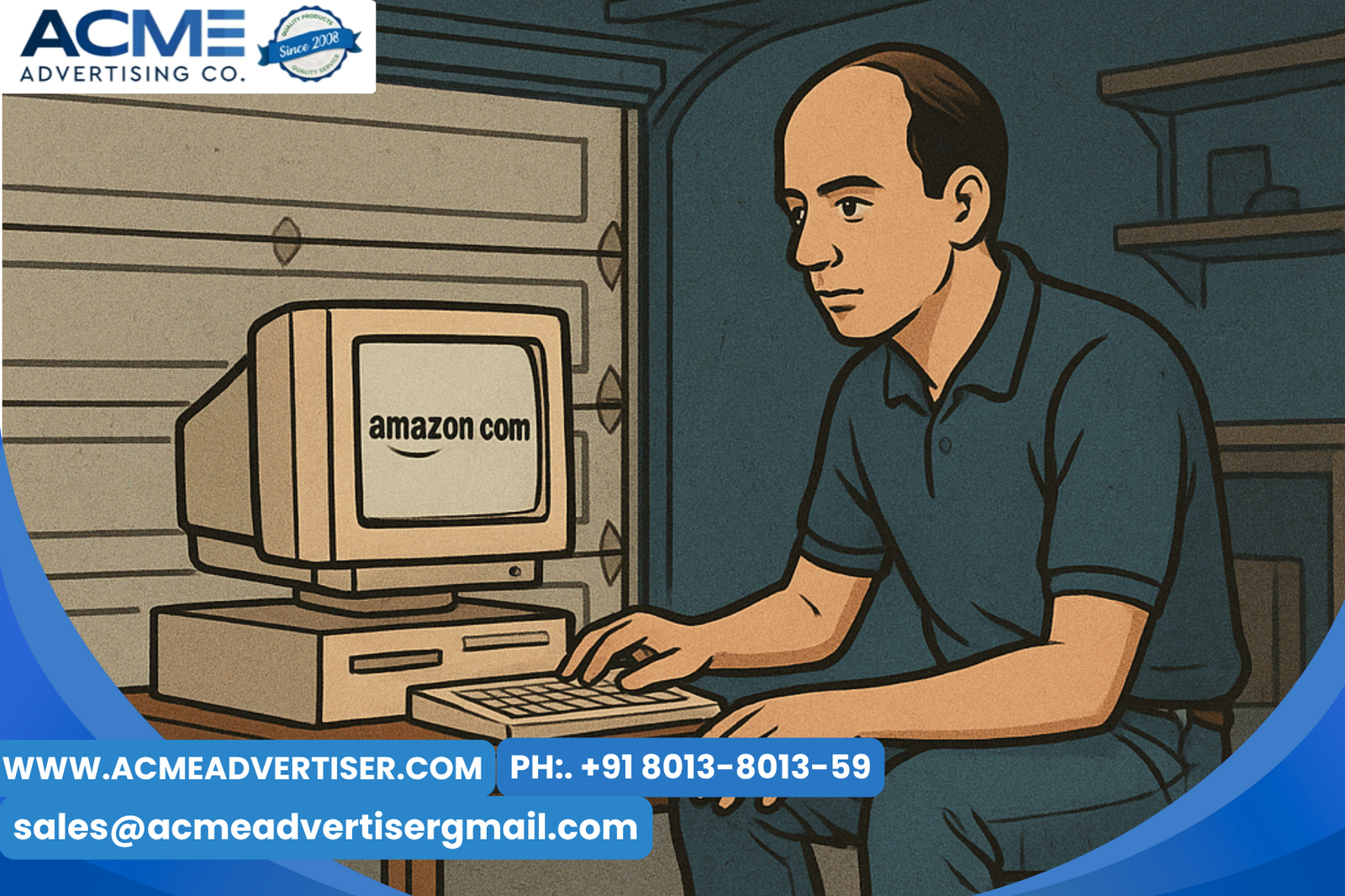
Picture this: mid-’90s Seattle—flannel shirts, grunge music, and dial-up internet that sounded like an angry robot warming up. In a modest garage, Jeff Bezos sat cross-legged on the concrete floor sketching business models on a whiteboard bought with pocket change.
The hypothesis?
A digital-first retail model that never sleeps, scales like wildfire, and leverages marketing as a strategic flywheel—not a cost center.
It wasn’t glamorous. It wasn’t guaranteed.
But it was audacious. And in the corporate ecosystem, audacious usually pays compound dividends.
2. The Amazon Game Plan: Build Trust, Drive Traffic, Scale Relentlessly
Amazon’s early marketing strategy wasn’t about big-budget heroics—it was about precision, customer obsession, and data-driven storytelling. Bezos didn’t want customers to buy something; he wanted them to buy in.
The Three-Phase Flywheel
- Awareness: Make Amazon the default online shopping destination
- Acquisition: Turn first-time buyers into habitual purchasers
- Acceleration: Use data loops, personalization, and channel diversification
Here’s Amazon’s early growth snapshot:
Table 1: Amazon’s Early Growth Indicators (1996–2001)
| Year | Active Users | Net Sales (USD) | Key Marketing Play |
|---|---|---|---|
| 1996 | 180,000 | $15.7M | Email outreach + PR |
| 1998 | 2.5M | $610M | Category expansion + partnerships |
| 2000 | 20M | $2.7B | Personalization engine launch |
| 2001 | 30M | $3.1B | Marketplace model begins |
Clearly, the rocket wasn’t waiting for clearance. It launched.
3. Amazon’s Marketing Breakthroughs: The Moves That Changed the Industry
The Personalization Engine: Not just “Customers who bought this also bought that”—it was behavioral economics blended with machine learning. Amazon made product discovery feel like destiny, not chance.
The Prime Power Play: A logistical masterstroke disguised as a membership program. Standard marketers saw shipping costs. Amazon saw a loyalty platform wrapped in a value proposition.
Multi-Channel Integration:Amazon never said, “One channel is enough.”
It built an ecosystem—search, email, OOH, partnerships, TV, direct response, Alexa, devices, web, mobile apps. A symphony, not a solo.
The Marketplace Expansion: Suddenly Amazon wasn’t just the store—it was the marketplace. The brand narrative shifted from a retailer to an indispensable infrastructure.
4. Chart Time: Amazon’s Marketing Growth Curve
Below is a simplified visual snapshot (in textual chart form) highlighting Amazon’s marketing-influenced revenue trajectory.
Chart 1: Amazon Revenue Growth Driven by Marketing (1997–2010)
Revenue (in billions)
40 |                                      ████
35 |                                  ████
30 |                           ███████
25 |                        ███
20 |                    ███
15 |               ███
10 |         ████
 5 |    ███
 0 +------------------------------------------------
       1997 1999 2001 2003 2005 2007 2010
Marketing wasn’t just a lever—it was the entire engine assembly.
5. The Story Behind the Strategy: How Amazon Rewired Consumer Behavior

Imagine walking into a store where:
- Everything you want is in stock
- Your past preferences predict your future needs
- Checkout takes seconds
- Delivery is faster than your morning chai
Amazon didn’t “advertise convenience”—they institutionalized it.
They turned consumer habit into corporate moat.
They built loyalty not through discounts, but through relevance and reassurance.
And yes—this is where most brands quietly whisper, “We want that.”
6. The Big Marketing Lesson for Modern Brands

Brands today don’t need Amazon’s budget—they need Amazon’s mindset:
The Four Amazon Principles:
- Customer-obsessed positioning
- Data-backed decisioning frameworks
- Channel diversification at scale
- Brand consistency across touchpoints
If you get these right, your marketing no longer pushes your brand.
It pulls your audience.
7. Bridging the Case Study to Your Brand Reality
Here’s the corporate truth serum moment:
Most businesses don’t lose customers because of bad products—they lose them because of invisible brands.
And visibility?
That’s where ACME Advertising Co. enters the battlefield like the commando unit your marketing never knew it needed.
8. How ACME Advertising Co. Helps Brands Build Their Amazon-Like Dominance
Just as Amazon scaled with multi-channel muscle, ACME champions brands with a 360° media ecosystem that turns touchpoints into triggers and audiences into advocates.
Let’s break it down.
A. OOH Media: Your Brand, But Billboard-Boss Mode
OOH is the corporate equivalent of taking center stage in a pitch meeting—you simply cannot be ignored.
We amplify brand visibility across:
Highways, Metro stations, Corporate hubs, Airport zones and High-footfall retail clusters.
From massive hoardings to clever gantry placements, your brand stays front and center in the consumer psyche.
B. Retail Media: Influence at the Point of Purchase
Shoppers decide fast—and emotionally.
ACME ensures your brand gets the last word before the wallet opens:
In-store branding, Shelf strips & danglers, Mall atriums, Pop-up promotional zones, Hyperlocal brand activations, We don’t just drive footfall—we convert it.
C. Transit Media: Mobility Meets High Impressions

Amazon mastered convenience.
Transit media masters frequency.
And frequency drives recall like nothing else.
We deploy across:
Metro trains, Buses, Autos, Cabs and Railway stations.
Your brand becomes the constant companion of the urban commuter.
D. Electronic Media: The Digital Amplifier
Screens are where engagement skyrockets.
ACME taps into:
Digital signages
DOOH networks
LED façade displays
Airport screens
Mall networks
Think of this as your brand’s 24/7 showroom.
E. POSM Media: Where Brand Meets Behavior
The moment of truth happens at POS.
ACME’s POSM design and deployment bring brands to life exactly where customers decide:
Standees, Glow sign boards, Counter-top branding, Posters, Kiosks, Retail display innovation
From first glance to final conversion—we shape the journey.
9. Why Brands Trust ACME Like a Strategic Growth Partner
ACME is not just an advertising agency—it’s a revenue-aligned marketing partner engineered to deliver measurable outcomes:
Enhanced brand recall

Optimized media ROI
High-frequency audience exposure
Location-intelligent deployments
Full-service execution across geographies
Quality-controlled installations
Transparent reporting
We’re the Amazon-style operational efficiency your brand wants—minus the Seattle rain.
10. Final Takeaway: What the Amazon Story Means for You
Amazon’s ascent wasn’t accidental.
It was strategic, disciplined, and aggressively consumer-centric.
If your brand can mirror even 10% of that philosophy—and anchor it to high-impact media platforms—you’ll unlock disproportionate growth.
And that’s exactly what ACME Advertising Co. delivers:
Multi-channel visibility powered by strategy, creativity, and execution excellence.
11. Ready to Build Your Own Amazon-Style Success Story? Let’s Activate.
You’re one strategic conversation away from transforming your brand visibility into market dominance.
What can brands learn from Amazon: A Marketing Case Study That Rewrote the Playbook?
Amazon’s marketing approach demonstrates how a brand can combine customer understanding, convenience, technology, personalised communication, and multiple marketing channels into one connected customer experience. Rather than depending on a single advertising format, the company has built marketing around different stages of the customer journey.
For brands operating in the UAE, this approach highlights the importance of understanding local customer behaviour before selecting marketing channels. Businesses targeting customers in Dubai, Abu Dhabi, Sharjah, or other emirates can combine digital communication with outdoor, social, search, retail, and other relevant touchpoints.
The broader lesson is that marketing works best when every channel has a defined purpose. A business can use outdoor advertising to build physical visibility, digital campaigns to support consideration, and online platforms to make the next customer action easier.
How did Amazon change the way brands think about customer-focused marketing?
Amazon’s marketing model places considerable emphasis on convenience and customer experience. Product discovery, information, purchasing, delivery, recommendations, and communication are connected within a broader ecosystem, reducing friction between different stages of the buying journey.
This provides a useful reference for UAE businesses that want to understand how customer expectations influence marketing decisions. Consumers in markets such as Dubai and Abu Dhabi interact with brands across websites, mobile devices, social platforms, physical locations, and advertising environments.
Businesses can apply the principle without copying Amazon’s exact strategy. The practical approach is to identify where customers discover a brand, what information they need before making a decision, and which channels can support them at each stage of the journey.
What role does data play in Amazon’s marketing strategy?
Data can help marketers understand customer interactions, preferences, search behaviour, purchasing patterns, and responses to different communications. Amazon’s broader business model demonstrates how customer information can support personalisation and more relevant experiences across its ecosystem.
For UAE brands, data can similarly support decisions about audience segments, campaign timing, locations, creative messaging, and channel selection. Outdoor advertisers, for example, can use campaign objectives and available audience information to determine which locations are relevant rather than selecting sites purely on appearance.
However, data should support strategy rather than replace it. Businesses should define what they want to achieve first and then identify the information needed to make better marketing decisions. Privacy requirements and applicable UAE regulations should also be considered when collecting and using customer information.
How can UAE businesses apply lessons from Amazon’s marketing case study?
UAE businesses can apply the underlying principles by making customer needs central to campaign planning. Instead of treating every advertising channel independently, brands can create a connected strategy where outdoor visibility, digital campaigns, social media, search, and customer experience support the same business objective.
For example, a retail brand launching a new UAE outlet could combine billboard or digital outdoor advertising around relevant locations with search and social campaigns directing interested customers towards additional information. The messaging across these channels can remain consistent while adapting to each platform.
Campaign planning should also consider duration and geographic coverage. A business may begin with 3–5 relevant locations for a focused campaign or explore 5–10+ locations when broader coverage is required, depending on audience, budget, media availability, and campaign objectives.
What should businesses consider before using Amazon-inspired marketing strategies?
Businesses should avoid copying another company’s marketing activities without considering their own customers, products, market position, resources, and objectives. Amazon operates at a very large scale, so its methods cannot automatically be transferred directly to every UAE business.
Before launching a campaign, brands should define their target audience, marketing objective, geographic focus, budget, campaign duration, key message, and preferred channels. These factors help determine whether outdoor advertising, digital marketing, content, social media, search, or a combination of channels is appropriate.
A practical planning period can range from 7–14 days for short promotional activity, 15–30 days for a broader campaign cycle, or 30+ days for longer-term brand communication. The final plan should be based on the business objective rather than following a fixed template.
1. What can I learn from Amazon’s marketing strategy for my own business?
Amazon’s marketing approach shows how a business can combine convenience, personalization, strong digital experiences and customer-focused communication. For UAE businesses, these principles can be adapted to understand local customer behaviour and create marketing campaigns that make purchasing easier and more relevant.
How does Amazon use customer behaviour to improve its marketing?
Amazon uses customer interactions such as searches, browsing activity and purchasing patterns to personalize parts of the shopping experience. Businesses can apply a similar customer-focused approach by understanding what their audience searches for, what influences purchasing decisions and where customers prefer to interact with a brand.
3. What makes Amazon’s customer experience an important part of its marketing?
Amazon connects marketing with the overall customer journey rather than treating advertising as a separate activity. Easy product discovery, personalized recommendations, convenient purchasing and delivery all contribute to the experience. Businesses can similarly strengthen marketing by reducing friction between discovering a product and completing a purchase.
4. How can I apply lessons from Amazon’s marketing strategy to my UAE business?
You can focus on understanding your customers, simplifying the buying journey, using relevant communication and maintaining consistency across marketing channels. In the UAE, businesses can also adapt campaigns to different customer segments across markets such as Dubai, Abu Dhabi and Sharjah.
How does Amazon combine different marketing channels?
Amazon’s marketing ecosystem involves multiple customer touchpoints, including its website, app, email communication, advertising products and other digital channels. The broader lesson for businesses is to connect different channels so that customers receive a consistent brand message instead of experiencing disconnected campaigns.
6. What role does personalization play in Amazon’s marketing success?
Personalization can make marketing messages and product recommendations more relevant to individual customers. Businesses can use customer segments, purchase history and stated preferences where appropriate to create more relevant communication rather than delivering the same message to every potential customer.
Can Amazon’s marketing case study help me plan an advertising campaign?
Yes. The case study can provide useful principles for campaign planning, particularly around audience understanding, customer journeys, relevant messaging and measurable actions. These ideas can be combined with UAE-specific advertising channels such as digital advertising, outdoor media, cinema advertising and social media.
8. What is the biggest marketing lesson I can take from Amazon’s approach?
A key lesson is to view marketing as part of the complete customer experience. Instead of focusing only on attracting attention, businesses can consider how customers discover the brand, evaluate an offering, make a purchase and interact with the business afterward. This customer-focused approach can be adapted to different industries and UAE markets.
Connect With ACME Advertising Co.:
📞 +91 8013-8013-59
📧 sales@acmeadvertiser.ae
🌐 acmeadvertiser.ae
Website: www.acmeadvertiser.ae
LinkedIn: Acme Advertising Co